The released Qwen3-TTS Python API returns a complete waveform. That interface is suitable for offline synthesis, but it does not expose the model’s causal audio path to latency-sensitive applications.
I built a streaming service around the 0.6B model and deployed it on AWS. On an A10G, the endpoint returned its first audio in 187–189ms at p50 through an Application Load Balancer. CUDA graphs reduced generation RTF from roughly 1.70 to 0.35.
This post covers the inference runtime, WebSocket API, AWS deployment, and measurement methodology. The implementation and Terraform are open source.
Why Qwen3-TTS?
Qwen3-TTS is small enough for one 24GB A10G, supports voice cloning, and represents audio at only 12.5 codec frames per second. Fewer frames mean fewer autoregressive steps.
Its decoder is causal: it can turn completed frames into audio without waiting for future frames. That makes real streaming possible.
CUDA graphs, intuitively
Generating one audio frame runs hundreds of small GPU operations. Normally, the CPU schedules each operation separately. For a large batch, the useful computation hides that overhead. For one frame at a time, the repeated scheduling and launch costs matter.
A CUDA graph records a fixed sequence of GPU operations once, then replays the sequence with one CPU launch. This reduces the per-step CPU scheduling and kernel-launch overhead.
Qwen3-TTS has two repeated stages:
- The talker predicts the first codec token.
- The code predictor fills in the other 15 tokens for that frame.
faster-qwen3-tts captures one graph for each stage. Variable-length prompt processing stays outside the graphs; generated tokens go into preallocated KV caches with fixed shapes.

Every four completed frames, I decode and yield roughly 320ms of audio:
for audio, sample_rate, _timing in model.generate_custom_voice_streaming(
    text=text,
    speaker="ryan",
    language="English",
    chunk_size=4,
):
    yield audio.astype(np.float32), sample_rate
That is the difference between “generate, then slice” and actual token-level streaming.
The service
The API is intentionally small:
Client → WebSocket: {"text": "Hello world", "language": "English"}
Server → Client:    [float32 PCM chunk]
Server → Client:    [float32 PCM chunk]
Server → Client:    {"done": true, "sample_rate": 24000}
FastAPI handles the WebSocket while the synchronous GPU generator runs in a thread executor. The client package depends only on websockets and numpy, not PyTorch or CUDA.
The Base model also supports prompt-based voice cloning. A client registers a short reference clip once, then supplies its voice_id in later WebSocket requests. The current implementation keeps those references on local disk, so they disappear with the container.
Deploying it on AWS
The Docker image contains the model weights. At about 6.9GB compressed in ECR, it is large, but startup does not depend on a concurrent Hugging Face download.
Terraform creates:
- ECR for the image
- ECS on EC2, because Fargate does not expose GPUs
- GPU-backed EC2 capacity (
g5.xlargein this test) - an Application Load Balancer for the WebSocket
CUDA graph capture makes the first inference slow. The server therefore warms the model before its health endpoint returns 200. The cold start still exists, but it happens during deployment rather than on a user’s first request.
The one-instance benchmark deployment also revealed a rolling-update capacity constraint. ECS tried to keep the old task healthy while placing the replacement, but the old task still occupied the GPU. The deployment could not progress until I stopped the old task. GPU capacity and deployment policy must explicitly allow room for replacement tasks.
Measured results
I ran the official and CUDA-graph engines sequentially on the same g5.xlarge, using the 0.6B CustomVoice model, a fixed seed, and the same three inputs. Each condition had three warm-ups followed by 30 recorded runs.
Endpoint latency used one isolated client container on the same EC2 host, with every request still traversing the ALB. TTFA starts immediately before sending the request on an established WebSocket and ends at the first binary audio frame, so it excludes public-internet and connection-setup latency. A separate capacity study remeasured TTFA on a 20-prompt corpus under load; at concurrency one it reported 195ms p50 and 197ms p95, slightly higher than these three-prompt endpoint runs.
| Input | Official RTF p50 | CUDA graph RTF p50 | Deployed TTFA p50 / p95 |
|---|---|---|---|
| Short (5 words) | 1.71x | 0.36x | 187ms / 188ms |
| Medium (~40 words) | 1.70x | 0.35x | 188ms / 190ms |
| Long (~150 words) | 1.71x | 0.35x | 189ms / 190ms |
RTF is generation time divided by audio duration, so lower is better and anything below 1.0 is faster than playback. The CUDA-graph path was roughly 4.8× faster than the official path and generated audio at about 2.8× real time.
The streaming endpoint itself had a higher RTF of roughly 0.44 because repeatedly decoding small chunks trades some throughput for earlier audio. That trade-off is appropriate for a conversational agent.
The engines did not produce identical durations: optimised audio was 6–20% shorter across these three prompts. RTF normalises by each output’s duration, so the speedup is useful but not an identical-output comparison.
Hardware: NVIDIA A10G 24GB (g5.xlarge), driver 550.163.01, PyTorch 2.6.0 + CUDA 12.4, qwen-tts 0.1.1, faster-qwen3-tts 0.2.6, chunk_size=4.
Where first-audio latency goes
I followed this with a study of the current faster-qwen3-tts server and vLLM-Omni as alternative serving backends on one A10G. It covered packet sizes of one, two, four, and eight frames: 20 conditions, 60 measured requests each, and 1,200 successful requests.
The best isolated result was the current backend with one frame per packet: 107.8ms p50 and 109.3ms p95 TTFA, 0ms p95 starvation, and 0.70 p50 RTF. This is a smaller-packet result, not a comparison with Qwen’s reported four-frame result.
At four frames, which matches the reported packet size, the current backend measured 194ms p50 and 197ms p95 on localhost. The 97ms four-frame result was not reproduced. Qwen did not disclose enough hardware or measurement detail to establish a controlled comparison, so the gap cannot be assigned to a specific implementation or hardware difference. In this study, the four-frame path included about 110ms of first-packet decode, 38ms of prefill, and 41ms of unattributed engine work.
The one-frame waterfall below measured 37.7ms prefill, 27.7ms first-packet decode, 40.5ms unattributed engine work, and about 1.2ms combined serialisation, send, and transport. The 40.5ms is not a proven exact substage. It can include preparation, Code2Wav or audio decoding, and device-to-host conversion. Instrumenting that interval is the next profiling target.
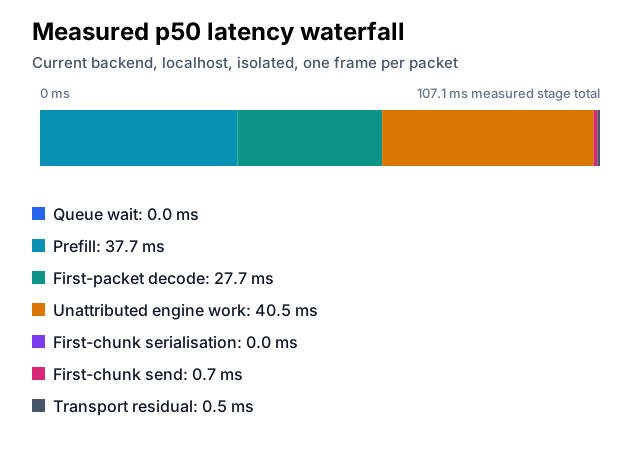
The ALB was not the bottleneck. Paired isolated requests put its contribution at only 0.7–1.1ms p50, depending on packet size.
Production is a separate result. One-frame packets optimise isolated onset, but no tested single-replica sustained condition met every SLO. The current backend queued severely. vLLM-Omni came closest with eight-frame packets, but still measured 376ms p95 TTFA and 102ms p95 starvation. I would validate bounded admission and/or multiple replicas rather than deploy any tested sustained policy unchanged.
Does streaming change the audio?
Usually slightly, but one of ten pairs ended 800ms early. Full and streamed waveforms were not bit-identical.
Nine of ten single test pairs had identical durations, with aligned SNR between 18.6 and 28.6dB; higher SNR means closer waveforms. One short sentence ended 800ms earlier in streaming mode and diverged substantially. Importantly, no chunk-boundary jump exceeded the 99th percentile of ordinary sample-to-sample jumps within its clip. The objective data therefore found no special spike at chunk boundaries, but it did find a real end-of-utterance edge case. This was not a systematic perceptual study, so the samples are included below for direct comparison.
Here is a representative high-SNR pair:
Full generation
Streaming
And the duration-mismatch case:
Full generation
Streaming
This is why I would not replace quality testing with a single latency number.
What this is and is not
This is a reproducible, deployable prototype, not a finished production service.
- Generation is serialised to protect the shared engine. A separate A10G capacity study found that this architecture meets the latency SLO at only one active request per replica under load.
- Voice references are ephemeral.
- The test ALB used plain HTTP/WebSocket with no authentication.
- Disconnecting stops delivery to the client, but I have not proved that it immediately cancels in-flight GPU work.
- Streaming is faster to first audio but slower in total throughput than full CUDA-graph generation.
These service engineering constraints matter before serving real traffic.
Try it
git clone https://github.com/CallumJMac/qwen-tts-serve.git
cd qwen-tts-serve
uv sync --extra cuda --extra dev

QWEN_TTS_ENGINE=faster uv run uvicorn qwen_tts_serve.server:app \
  --host 0.0.0.0 --port 8000
uv run python scripts/stream_demo.py "Hello world"
This true-streaming path requires an NVIDIA CUDA machine. Building a responsive service required more than calling model.generate(): CUDA graphs substantially reduced inference overhead, while warm-up, health checks, packaging, WebSockets, and deployment behaviour addressed the service-level requirements.
Comments